The People's Recovery: ensuring that everyone is included in the ongoing recovery efforts.
We can support both renters and homeowners with recovery money, but only if we're strategic about it
The City of Asheville is considering a move of $19.2 million in federal disaster recovery funding away from affordable housing construction and infrastructure projects into the State’s Renew NC home repair and reconstruction program. Helping storm-impacted homeowners remain housed is an important recovery priority. However, Hurricane Helene also displaced renters, intensified Asheville’s housing shortage, and increased housing insecurity throughout the community. We believe Asheville should pursue both homeowner recovery and affordable housing production while using limited recovery dollars in ways that help as many families as possible remain housed.
You can read more about this issue, and take action, at GAPavl.org. The deadline for submitting a public comment is Sunday, June 14th at 5 pm.
Prior Advocacy
Action Alert: Asheville considers major cut in affordable housing
A recent GAP Report focused on a major proposed policy change for the City of Asheville: a significant reduction in its planned use of recovery money for multifamily affordable housing. The City had earmarked $28 million for multifamily affordable housing from the $225 million in federal Community Development Block Grant Disaster Recovery (CDBG-DR) it got approved earlier this year. City staff are now proposing to cut that number by more than half, down to $11 million.
Partly because of our advocacy, the City has slowed down on this issue, and will announce their latest plans at the next Housing and Community Development Committee meeting on January 20th. If you subscribe at GAPavl, you'll get all the updates on this issue. You can subscribe here.
Let's Advocate for Deeply Affordable Housing
The People's Place AVL has been working to support Safe Shelter and Grace Covenant Presbyterian Church, which are working hard everyday (along with other local organizations) to address our local housing crisis. The three of us co-hosted a series of events on November 20 and 23 to offer updates and advocacy opportunities connected to the $28 million Asheville has earmarked for affordable multi-family housing construction.
This affordable housing spending is part of Asheville's Community Development Block Grant Disaster Recovery (CDBG-DR) plan. In keeping with that plan, the City will soon be seeking bids for developers to build new affordable housing -- and we wonder how affordable this housing will actually turn out to be. To satisfy the U.S. Department of Housing and Urban Development (HUD), it could all be minimally affordable, offering housing to moderate income families but not to the lower income folks who are most in need. There is still time to influence the City on this, so that they explicitly stipulate that they want to give priority to developers who are offering deeply affordable housing.
Background: The City of Asheville is set to receive $225 million in Community Development Block Grant Disaster Relief (CDBG-DR) money this year from the US Department of Housing and Urban Development (HUD).
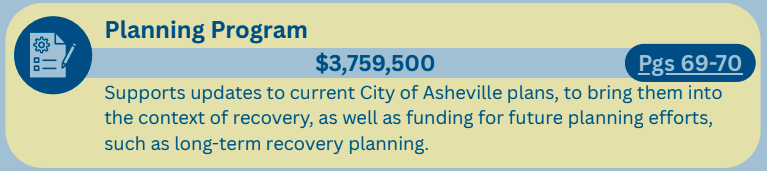
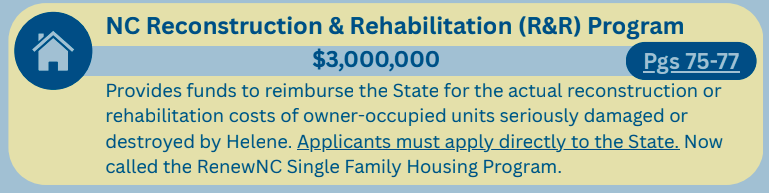
Here is the current breakdown of the $225 million into 8 programs.
The City can move up to $5 million into or out of any of these programs without having to get their plan reapproved by HUD.
The pages refer to the full plan, which you can access here. You can read about our earlier advocacy on this issue below.

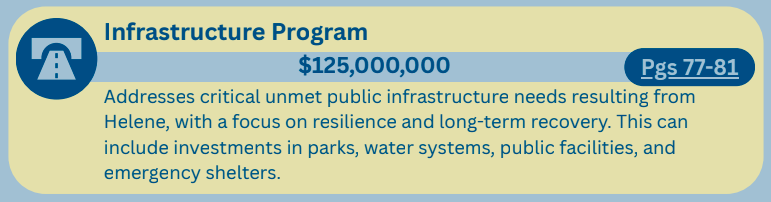


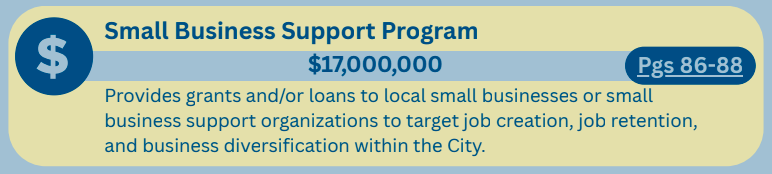
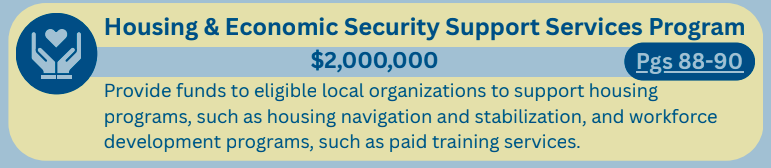
The City released a draft plan for how the HUD money would be used on March 4th, outlining programs to address housing, infrastructure, and economic recovery needs over the next six years. We organized a series of events to offer feedback before the April 3 deadline.
Below is a summary of the original plan, with the recommendations our People's Place advocates (in partnership with GAPavl) made in green.
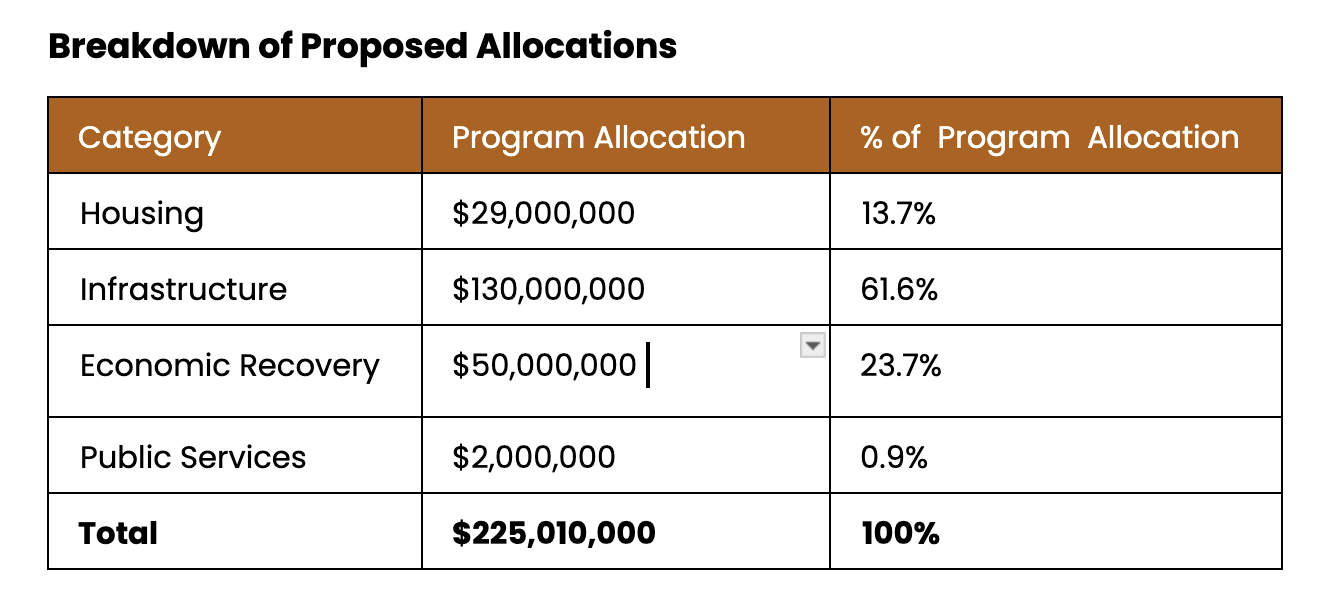
Proposed Housing Allocations: $29 million
$26 million for Affordable Multi-Family Housing Construction Program
$3 million for State of North Carolina Reconstruction and Rehabilitation of Owner-Occupied Housing (R&R) Program.
51% of this new housing must be “affordable” to those making 80% of the Area Median Income (AMI) - in Asheville, that means folks making $74,800. (48% of Asheville residents (and 81% of Black community members) make $50,000 or less.)
This allocation is too small - we should invest $35 million or more in affordable housing.
The plan should explicitly name that this money will be primarily used for deeply affordable housing, for those making 50% AMI or lower.
The plan should include an allocation for rental assistance.
Proposed Economic Recovery Allocations: $50 million
$30 million for the Revitalization of Commercial Districts
$15 million for small business support
$5 million for workforce development.
We should invest more in supporting small businesses ($25 million) and workers ($10 million). This still leaves $15 million to revitalize flooded commercial districts.
We should be investing in people more than places. If an entrepreneur lost their business in a flooded commercial district, we can support them to rebuild there - or to relocate - whatever will serve their need and the community’s interest. This will allow historical commercial districts to evolve, and make space for new growth in areas that are less prone to flooding, all while ensuring that people are prioritized.
Proposed Infrastructure Allocations: $130 million
For water system improvements, wastewater system improvements, stormwater management, parks, recreation, and arts and cultural facility development or improvement, transportation and connectivity, commercial district revitalization, affordable housing infrastructure support, and activities for emergency sheltering
While we do need to invest in things like water, wastewater, stormwater and other physical systems, we should also invest in community connectivity systems - overlapping mechanisms for tying our community together in crises, and for ensuring that all aspects of the recovery are receiving robust input from all sectors of the population.
After the storm, those who were well-connected - to neighbors, a church, neighborhood association, or other local institution - were much more resilient. Thousands of people were disconnected and therefore disproportionately vulnerable. Our community connectivity - or lack thereof - is a key element of our City’s infrastructure, and should be part of plans to improve it. We need to fund community-based organizations so they can knock on more doors and talk to more people to get real-time feedback on their unmet needs. This will not only make our City government better informed but will ensure that our communities are more resilient in future crises.